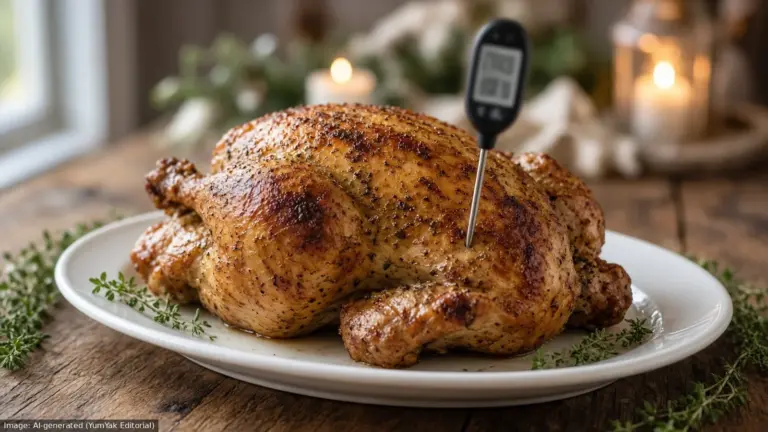
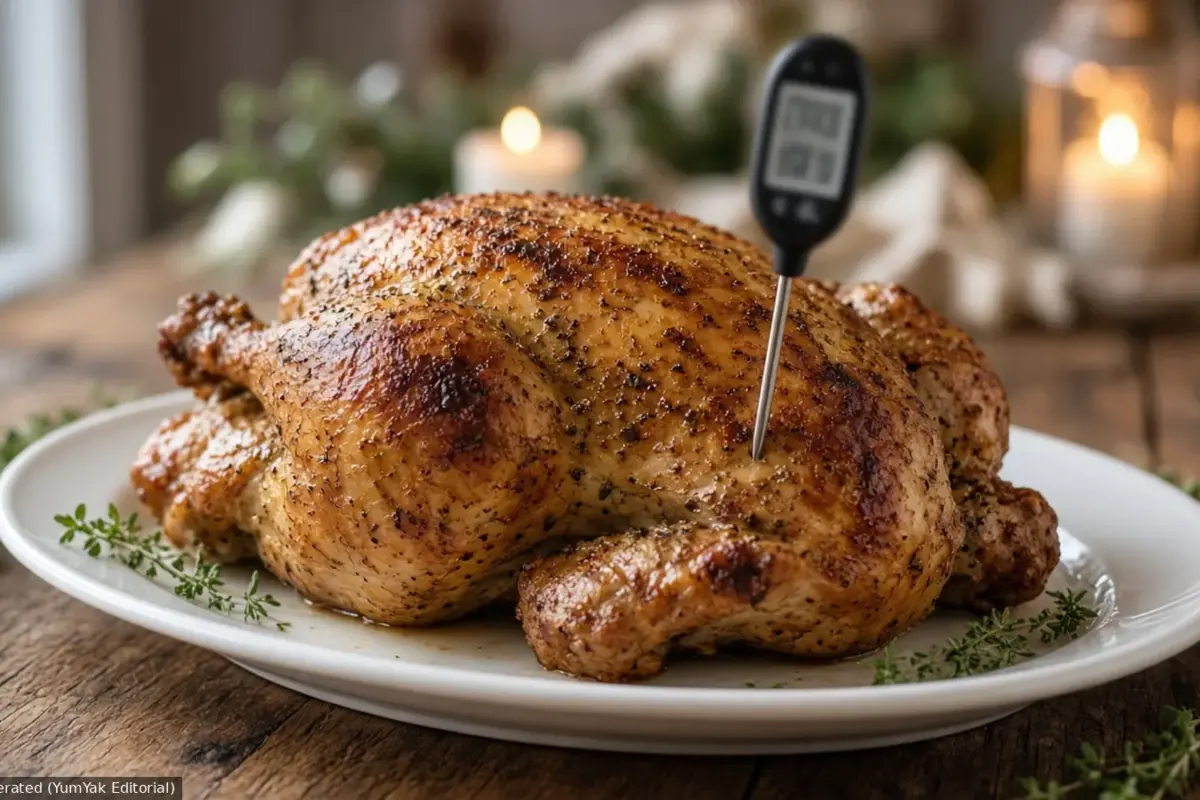
The pop-up timer stuck in some supermarket turkeys, the “juices run clear” test and the hours-per-kilogram chart on the wrapper share one flaw. None of them tells you the temperature inside the bird. A thermometer does, and it’s the only reliable way to serve a turkey that’s both safe and still juicy. This guide covers the temperatures Health Canada sets for a whole bird and for stuffing, exactly where to put the probe, which kind of thermometer suits a holiday roast, and the thawing math you need before any of it.
The numbers that matter
| What | Health Canada target | Where to check |
|---|---|---|
| Whole turkey (or chicken, duck) | 82°C (180°F) | Thickest part of the thigh, not touching bone |
| Turkey pieces (breast, legs, thighs) | 74°C (165°F) | Centre of the thickest piece |
| Stuffing, in the bird or baked alone | 74°C (165°F) | Centre of the stuffing |
| Leftovers, reheated | 74°C (165°F) | Centre of the dish |
These figures are from Health Canada’s safe cooking temperature chart, updated in 2024. If you’ve an older cookbook, you may see 85°C; Health Canada itself used that figure in a 2006 Thanksgiving reminder. Follow the current chart.
Where to put the probe
- Thigh first. Slide the probe into the thickest part of the thigh, aiming toward the body, and stop before you hit bone. Bone conducts heat and gives a falsely high reading. Health Canada’s instruction is to go through the thickest part to the middle without touching bone.
- Check the other thigh. Ovens have hot spots; the two sides often differ by several degrees. Use the lower reading.
- Then the breast. Insert from the neck end, parallel to the bone, into the thickest part. The breast usually gets there first, which is why it dries out.
- Then the stuffing. If the bird is stuffed, the centre of the stuffing must reach 74°C even if the meat is done. This is the main reason Health Canada recommends baking stuffing separately.
- Clean the probe between readings if you’re moving from raw-looking areas to cooked ones, and wash it in warm, soapy water after use.
Which thermometer suits a holiday roast
| Type | How it works | Good for | Watch out for |
|---|---|---|---|
| Digital instant-read | Fold-out or pen-style probe, reads in a few seconds | Spot-checking thighs, breast and stuffing; every other cooking job all year | Don’t leave it in the oven; you open the door to check |
| Leave-in probe with cable | Probe stays in the thigh; display sits outside the oven | Watching the climb without opening the oven; alarms at a set temperature | Only reads one spot; still confirm other spots with an instant-read |
| Oven-safe dial | Analog dial stays in the meat | Cheap backup | Slow and harder to read accurately; thick stem |
| Pop-up timer | Plastic button pops at a preset temperature | Nothing on its own | Reads one spot, can stick; Health Canada recommends a digital thermometer |
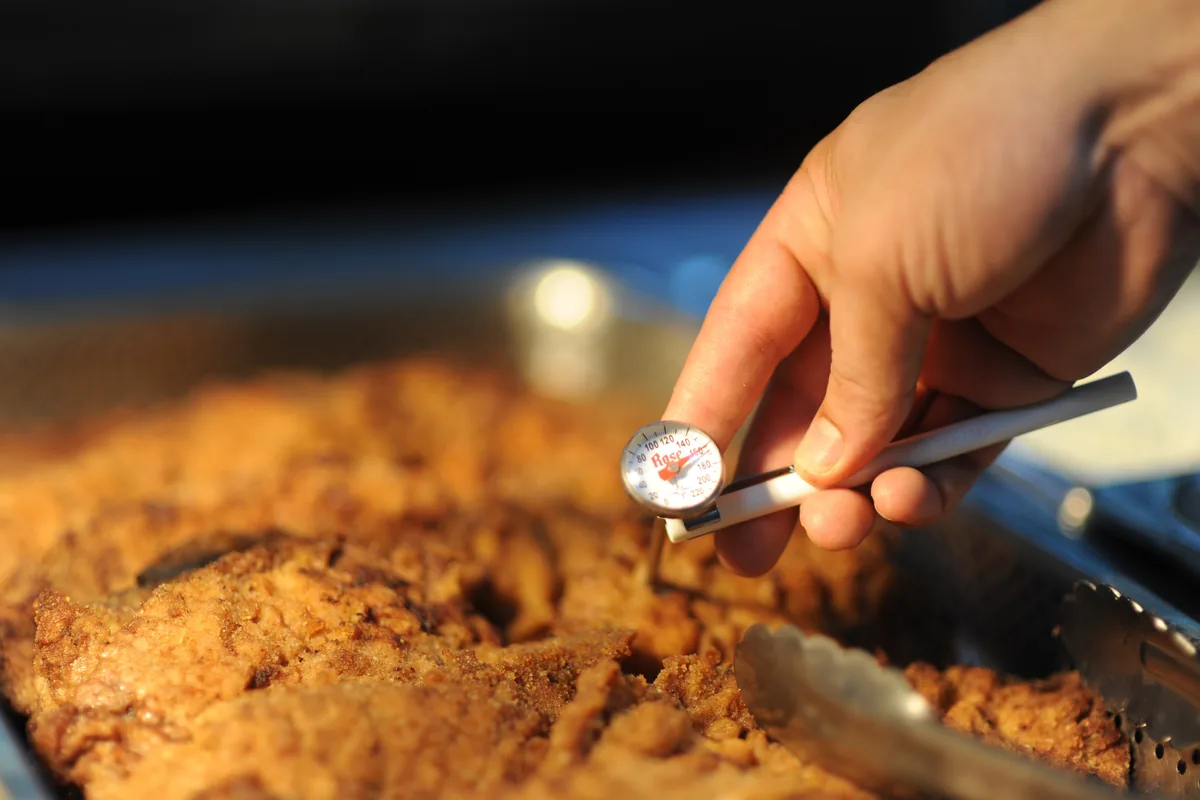
| Clip-on fry/candy | Long probe clipped to a pot | Oil temperature for deep-fried turkey, candy, sugar work | Not designed for meat probing |
If you buy one tool this season, make it an instant-read. The ThermoPro TP19H, which we’ve researched for earlier guides, is a fold-out digital model. A clip-on probe such as the TempPro TempDip is the right tool if you’re deep-frying a turkey or making candy, not for checking the bird itself. If you’d rather watch the temperature climb without opening the oven, a leave-in probe with a cable, such as the ThermoPro TP-16, stays in the thigh while the display sits outside the oven. We haven’t put any of them through a hands-on test; the picks come from product specs and listings.
Check your thermometer before the big day
A thermometer that reads 3 degrees low can leave you with an underdone thigh. Test it a few days ahead: fill a glass with ice, top it up with cold water, stir, wait a minute, and insert the probe without touching the glass. A slurry of ice and water sits at 0°C (32°F). If yours reads more than a degree off, recalibrate it following the maker’s instructions, or note the offset and adjust your readings.
Thawing comes first
A partly frozen bird cooks unevenly, and the thermometer can read done in one spot while another is still cold. Health Canada’s guidance is to thaw poultry in the refrigerator for 24 hours per 2.5 kg (5 lb):
| Turkey weight | Fridge thawing time | Start thawing (for a Dec. 25 roast) |
|---|---|---|
| 4.54 kg (10 lb) | 48 hours | Dec. 23 morning |
| 5.67 kg (12.5 lb) | 60 hours | Dec. 22 evening |
| 6.8 kg (15 lb) | 72 hours | Dec. 22 morning |
| 9 kg (20 lb) | about 96 hours (same ratio) | Dec. 21 morning |
If you’re short on time, Health Canada also allows thawing in cold water: keep the turkey in leak-proof packaging, fully submerged, and change the water every 30 minutes. Never thaw it on the counter. Cook it as soon as it has thawed.
Smaller roasts and other birds
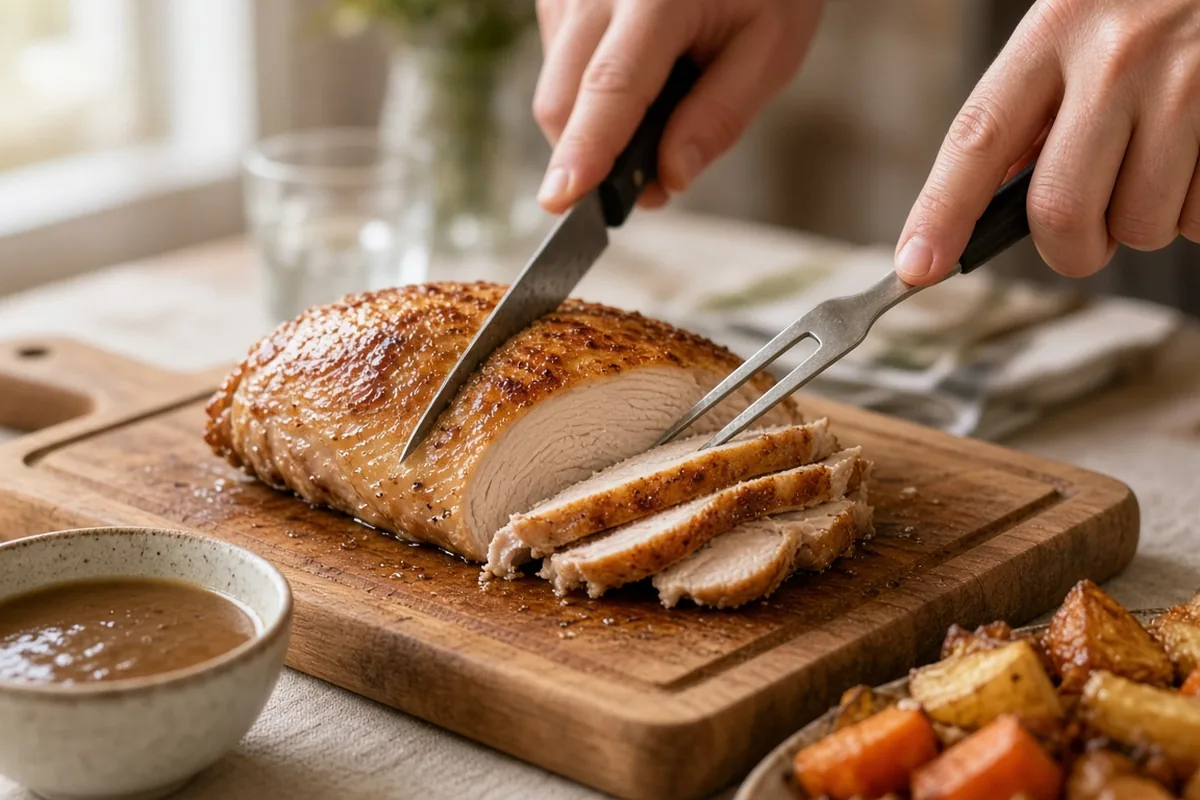
A boneless turkey breast roast, a spatchcocked bird or a tray of turkey legs plays by different rules. Health Canada treats those as pieces, so the target is 74°C (165°F) in the thickest part rather than 82°C. Check each piece separately if you’re roasting several. The same chart covers duck and goose: 82°C for a whole bird, 74°C for pieces. Small roasts climb fast in the last 20 minutes, so start checking earlier than you think you need to.
Resting and carving
Once the thigh reads 82°C, take the turkey out, tent it loosely with foil and let it rest for 20 to 30 minutes before carving. The juices settle back into the meat and the bird is far easier to slice. Carve the legs off first, then the breast in one piece, and slice across the grain.
After dinner: leftovers
- Refrigerate leftovers within two hours of cooking, in shallow containers.
- Take all the stuffing out of the bird before storing either.
- Cut the meat off the bones before refrigerating a large bird; it cools faster.
- Reheat to 74°C, and bring gravy and soup to a rolling boil.
Use the carcass the next day: our chicken pho method works with a turkey frame, and the noodle soup tools guide covers pot sizes for big carcasses.
Related
Tours